
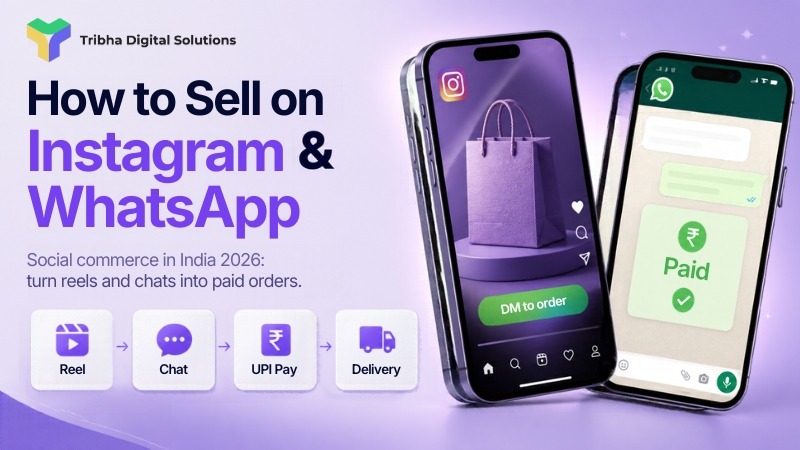
A customer sees your reel on Instagram. They tap your product tag, send a message, and ask about size and delivery. You reply on WhatsApp, send a UPI link, and they pay. Total time: ten minutes. No website was opened.
This is how many Indian customers buy today. But most small businesses lose sales in the middle of this journey because they reply late, have no system, or send messages the wrong way. This blog shows you how the journey works and where to fix it.
How Indian Customers Actually Buy
Most social sales in India follow the same path:
Reel → Profile visit → Product tag or link → DM or WhatsApp chat → UPI payment → Delivery
Instagram creates interest. WhatsApp closes the sale. Your job is to remove every small delay between these steps.
One thing worth knowing: even though many sales start in WhatsApp chats, most customers still pay through their UPI apps or payment links. One 2026 report found that WhatsApp Pay handled about 168 million transactions in July 2026, while total UPI volume was over 23 billion. That is less than 1%. So do not depend on in-chat payment alone. Always send a UPI link or QR code that works in any app.
Step 1: Get Attention with Reels That Sell
A reel that sells is different from a reel that only gets views. Show the product in use, show the price range, and say clearly what to do next, such as "Message us on WhatsApp to order."
Tag your products where possible, and put your WhatsApp link in your bio. If people have to hunt for how to buy, many will leave.
Step 2: Use Instagram DMs and WhatsApp Together
Both apps have a job:
Instagram DM: Good for first questions from people who just discovered you, mostly younger buyers.
WhatsApp: Better for confirming the order, sharing the catalog, sending payment links, and giving delivery updates.
A simple method: answer first questions on Instagram, then say "I'll send the details on WhatsApp" and move the chat there.
Step 3: Pick the Right WhatsApp Tool
There are two versions, and many businesses pick the wrong one.
WhatsApp Business App (free): Good for small shops. You get a catalog, quick replies, labels, and greeting messages. It works from one phone and becomes hard to manage once chats grow beyond what one person can handle.
WhatsApp Business API (paid): Built for growing businesses. Several team members can use one number, you can send approved message templates to many opted-in customers, and you can connect it to a CRM or chatbot. You usually access it through a provider.
What does the API cost? Meta charges per delivered template message, not per conversation, since July 2025. In India in 2026, marketing messages cost roughly ₹0.80 to ₹1.10 each depending on the provider, and utility messages (order updates) cost roughly ₹0.12 to ₹0.15. Replies to a customer who messaged you first, inside the 24-hour window, are generally free. On top of this, providers add platform fees and 18% GST. Meta has changed rates more than once this year, so always check the current rate card before you plan a budget.
Step 4: Use Click-to-WhatsApp Ads
Instead of sending ad clicks to a website, you can run Facebook and Instagram ads with a "Send WhatsApp message" button. The customer lands directly in a chat with you.
Many agencies report that this format works better than web forms for local services and high-priced products, because people get answers right away. Results depend on your product and your reply speed, so test it with a small budget first. Remember that an ad is only as good as your follow-up. If you reply the next day, the lead has already gone.
Step 5: Fix Payments and Returns
Payments and cash on delivery cause most of the losses in Indian social selling.
Send a UPI payment link or QR code in the chat. Make it one tap.
Send an order confirmation with the product, price, and delivery date right after payment.
If you offer cash on delivery, message the customer to confirm the order before shipping. Offer a small discount for paying online. This helps reduce returns from fake or unconfirmed orders.
Give GST invoices if your business needs them.
Step 6: Follow the Rules
Do not add people to broadcast lists without permission. India's DPDP Act (2023) is now in force, and WhatsApp also limits accounts that send unwanted messages.
Ask customers for permission before sending offers. Do this on your website, at checkout, or through your ads.
Make it easy to say "stop."
Send useful messages, such as order updates and restock alerts, more often than sales messages.
Step 7: Track What Matters
Do not count only followers and likes. Track:
Messages received from reels and ads
Reply time (aim to answer within a few minutes during working hours)
Chats that become orders (your real conversion rate)
Cost per order from ads
Repeat customers from WhatsApp follow-ups
If you get many messages but few orders, the problem is usually slow replies, unclear prices, or a hard payment step.
A Simple 30-Day Plan
Week 1: Set up Instagram Business and WhatsApp Business. Add your catalog, greeting message, quick replies, and WhatsApp link in your bio.
Week 2: Post 4 to 5 reels showing products, customer results, and how to order.
Week 3: Run a small Click-to-WhatsApp ad with a clear offer. Track every chat.
Week 4: Follow up with people who asked but did not buy. Ask buyers for reviews and share them on your stories.
Mistakes to Avoid
Replying to messages after many hours
Hiding the price and making people ask
Sending bulk offers to people who never agreed to receive them
Relying only on in-chat payment
Using one personal phone for a business that gets hundreds of chats
Running ads with no plan to follow up on the leads
Final Thoughts
Social commerce in India works because the tools already match how people shop: discover on Instagram, chat on WhatsApp, pay by UPI. The brands that win are not the ones with the most followers. They are the ones that reply fast, make payment easy, and follow up politely.
Want help setting up your Instagram and WhatsApp sales system, including ads and content? Tribha Digital Solutions can plan and run it for you.
